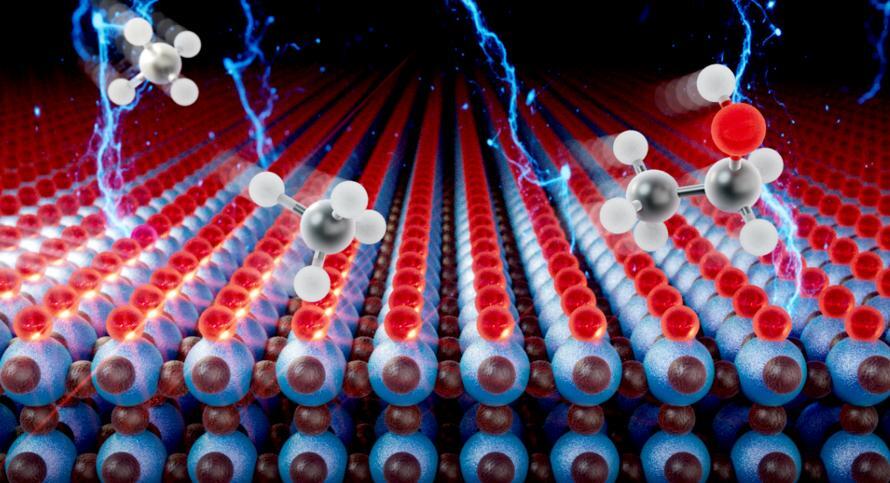
전기 에너지를 화학 에너지로 전환하는 전기화학 변환 기술은 청정 수소 생산과 탄소 자원화의 핵심 기반으로 평가받습니다. 물을 분해해 깨끗한 수소를 만들고, 배출되는 이산화탄소(CO₂)와 메탄(CH₄)을 연료나 고부가가치 화합물로 되돌리는 일이 모두 여기에 속합니다.이 반응들의 효율과 선택성은 결국 촉매 표면, 그중에서도 반응이 실제로 일어나는 원자 단위의 활성 자리(active site)에서 결정됩니다. 우리 연구실은 이 활성 자리를 나노스케일에서 설계합니다. 물 분해 반응에서는 금속 원자를 낱개 단위로 분산시킨 단일 원자 촉매로 원자 하나하나를 반응에 활용합니다. 또한, 촉매의 전자구조를 조절해 반응 경로를 유도함으로써, 여러 부산물 대신 원하는 생성물이 선택적으로 만들어지도록 합니다.
전기화학 촉매 표면 반응 시뮬레이션 렌더링
우리 연구가 지향하는 바는 활성이 높은 촉매를 확보하는 데 그치지 않습니다. 그러한 성능이 왜 나타나는지를 과학적으로 규명하는 것이 더 본질적인 목표입니다. 이를 위해 반응이 진행되는 실시간 상태를 관찰하는 operando 분석과, 반응 에너지와 경로를 예측하는 계산화학 분석을 병행하여, 표면에서 생성·소멸하는 반응 중간체와 메커니즘을 정량적으로 규명합니다.
주요 연구 분야
물 분해 반응 기반 청정 수소 생산을 위한 고활성 촉매 설계
CO₂ 및 CH₄ 전환을 통한 연료·고부가가치 화합물 생산 시스템 개발
operando 분석과 계산화학을 통한 반응 중간체 및 메커니즘 규명
머신러닝을 활용한 전기촉매·전극 최적화 연구
머신 러닝 기반 전기화학 반응 최적화 개념도
전기화학 반응은 촉매 구조, 전극 조성, 전해질 조건 등 여러 요소가 함께 작용해 성능이 결정됩니다. 본 연구실은 이러한 요소들을 효율적으로 분석하기 위해, 실험 데이터와 계산 결과를 머신러닝 기법으로 처리하여 전극 구성과 반응 조건을 빠르게 최적화하는 연구를 진행하고 있습니다. Gaussian Process Regression(GPR) 등 예측 모델을 활용해 반응 조건 변화에 따른 성능 추세를 파악하고, 어떤 변수가 성능에 영향을 주는지 정리합니다. 이를 통해 실험 횟수를 줄이면서도 원하는 성능을 얻을 수 있는 조합을 효과적으로 찾을 수 있습니다. 이러한 접근은 촉매·전극 설계를 체계화하고, 실제 응용이 가능한 구조를 개발하는 데 도움을 줍니다.
주요 연구 분야
다변수 실험 조건 분석 및 최적화(DOE–ML 결합)
실험·계산 데이터를 활용한 구조–성능 관계 분석
촉매·전극 성능 향상을 위한 최적 조성 및 조건 탐색
리튬-황 및 전고체 배터리 연구
리튬-황(Li–S) 배터리는 기존 리튬이온 배터리에 비해 높은 이론 에너지 밀도와 풍부한 원재료의 장점을 바탕으로 차세대 이차전지로 주목받고 있습니다. 그러나 황이 전해질에 용해되며 발생하는 다단계 전기화학 반응, 방전 생성물의 비균일한 침전, 전해질과의 부반응 등으로 인해 충방전 효율이 저하되고 셀 수명이 단축되는 문제가 있으며, 이로 인해 실제 응용에는 여러 기술적 장벽이 존재합니다. 우리 연구실은 이러한 문제를 해결하기 위해, 황의 손실과 확산을 억제할 수 있는 나노구조 탄소 전극 소재를 개발하고 있으며, 전기화학 반응의 선택성과 속도를 조절할 수 있는 촉매를 전극에 도입하여 전체 반응의 균일성과 안정성을 향상시키고자 합니다. 또한, 반도체 공정 기술에서 착안한 정밀 합성 전략과 건식 공정을 기반으로 한 고밀도 나노입자 코팅 기술을 적용하여 전극 계면의 반응 특성을 제어하고, 소재의 구조적·화학적 안정성을 높이는 연구를 진행하고 있습니다. 이와 더불어, 액체 전해질의 누액 위험성과 계면 불안정성을 극복할 수 있는 고체 전해질 기반의 전고체 배터리 시스템도 개발 중입니다. 우리는 고체 전해질과 전극 계면에서의 반응 안정성을 확보하고, 리튬이온 전도 특성을 향상시키기 위한 구조 설계 및 계면 조절 기술을 적용하여, 장기 안정성과 고에너지 밀도를 동시에 충족할 수 있는 고체 배터리 플랫폼을 구축하고자 합니다.
리튬-황 전지용 야누스 전극 구조
리튬-황(Li–S) 배터리는 높은 이론 에너지 밀도와 풍부한 원재료인 황 덕분에 차세대 이차전지로 주목받고 있습니다. 하지만 황이 전해질에 용해되면서 발생하는 다단계 전기화학 반응, 방전 생성물의 비균일한 침전, 전해질과의 부반응 등은 충방전 효율 저하와 셀 수명 단축의 주요 원인입니다.
Lithium–Sulfur and All-Solid-State Battery Research
Janus Electrode Design for Lithium–Sulfur Batteries
Lithium–sulfur (Li–S) batteries are gaining attention as next-generation secondary batteries due to their high theoretical energy density and the abundance of elemental sulfur.
However, challenges such as multistep electrochemical reactions caused by sulfur dissolution, inhomogeneous precipitation of discharge products, and side reactions with the electrolyte reduce efficiency and limit cycle life.
To overcome these barriers, our lab develops nanostructured carbon electrodes to suppress sulfur loss and diffusion, and integrates catalytic components to control reaction selectivity and kinetics.
We also employ precision synthesis and dry-processed nanoparticle coatings inspired by semiconductor manufacturing to tune interfacial characteristics and enhance material stability.
In addition, we are developing all-solid-state battery systems that eliminate leakage risks and interfacial instability of liquid electrolytes.
By engineering interfaces and lithium-ion transport mechanisms, we aim to realize solid-state batteries with long life and high energy density.
Key Research Areas
Nanostructured carbon electrodes to suppress sulfur dissolution
Catalyst-integrated electrode design for reaction efficiency
Dry-processed nanoparticle coatings for interface control
Precision synthesis of composite materials based on semiconductor fabrication
Interfacial stabilization of solid electrolytes and electrodes
Enhanced lithium-ion transport in solid-state systems
Electrocatalyst Research for Hydrogen and Greenhouse Gas Conversion
Visualization of surface reactions in electrocatalysis (simulation rendering)
Electrochemical conversion technologies that transform electrical energy into chemical energy are essential for hydrogen production, carbon valorization, and power-to-chemicals systems.
Our lab develops electrocatalysts with nanoscale precision to improve the efficiency, selectivity, and stability of energy conversion reactions.
We design single-atom catalysts (SACs) and heterostructure-based materials for high-efficiency hydrogen production via water splitting (HER and OER) in both acidic and alkaline media.
We also develop systems for the electrochemical conversion of CO₂ and CH₄ into fuels and value-added products, focusing on catalyst electronic structure control, reaction pathway selectivity, and interfacial kinetics.
Using operando techniques and computational chemistry, we quantitatively probe reaction mechanisms and aim to deliver robust, high-performance catalysts for practical applications.
Key Research Areas
Electrocatalysts for hydrogen production via water splitting (HER/OER)
Design of electrochemical systems for CO₂ and CH₄ conversion
Single-atom and heterostructure catalyst optimization
Reaction selectivity control via pathway and electronic structure engineering
Mechanism elucidation via operando analysis and computational modeling
Machine learning guided optimization of electrocatalysts and electrodes
Conceptual illustration of machine learning guided electrochemical optimization
Electrochemical reactions are governed by many coupled factors, including catalyst structure, electrode composition, and electrolyte conditions. Our lab uses machine learning to efficiently analyze these parameters and rapidly optimize electrode configurations and reaction environments. By training prediction models such as Gaussian Process Regression(GPR) on experimental and computational data, we map performance trends as conditions change and identify which variables most strongly influence activity. This approach reduces the number of experiments required while still finding combinations that deliver the desired performance. It provides a systematic framework for catalyst and electrode design and supports the development of structures that are ready for real applications.
Key Research Areas
Multivariable experiment analysis and optimization using DOE and machine learning together
Structure and performance relationship analysis based on experimental and computational data
Search for optimal compositions and conditions for improved catalyst and electrode performance